
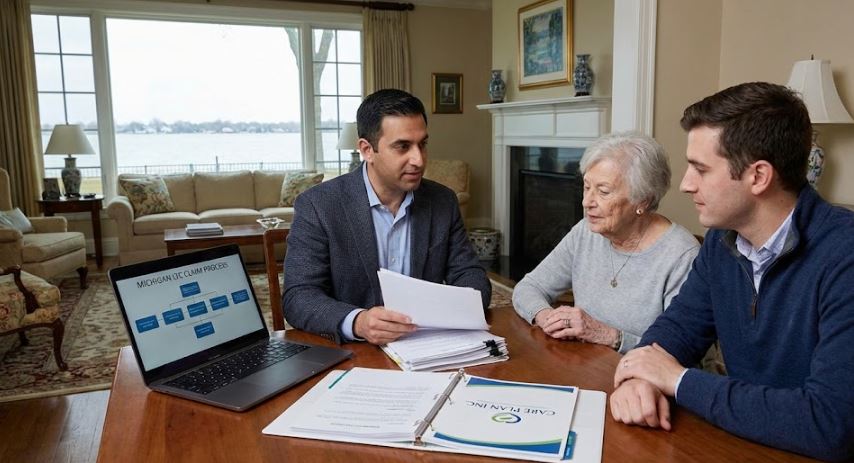
“From an operations standpoint, VA home care hours are not a fixed ‘number’—they’re a staffable plan built around tasks and risk windows. When families describe needs in routines (transfers, toileting safety, bathing) instead of diagnoses, it’s easier to translate that need into an authorized plan that can actually be scheduled.” — Sam Noor, CEO & Administrator. This is particularly relevant for families navigating VA H/HHA Michigan.
Understanding the “Approval Shock”
If you are caring for a Veteran in Michigan, few things are more frustrating than the “Approval Shock”. You fight for months to get into the system, only to receive a letter authorizing a mere 6 hours per week. For a family managing a Veteran who needs help getting out of bed every morning and using the bathroom throughout the day, 6 hours covers almost nothing.
There is often a massive gap between what a family needs and what the VA authorizes under the Homemaker and Home Health Aide (H/HHA) program in Michigan. Many assume hours are based on a diagnosis like Parkinson’s or Dementia, but the system actually relies on a rigid formula of tasks, safety risks, and caregiver gaps. In Michigan, authorized hours on paper and staffed hours at your door are two different things, heavily influenced by local agency capacity and winter weather. Understanding the intricacies of VA H/HHA Michigan can help bridge this gap.
The “Black Box” of Authorization
The Difference Between “Need” and “Authorization”
The VA H/HHA program is not a “sitter service” designed for 24/7 safety supervision. If you request hours simply because you are afraid to leave a Veteran alone, the VA will likely deny the request or refer you to Respite Care, which is strictly capped.
Instead, the VA authorizes Task-Based Support. Social workers from Michigan VA centers (like those in Battle Creek, Saginaw, or Detroit) act as auditors of daily movement. They ask specific questions: Can the Veteran bathe safely? Can they transfer to the toilet without falling? Can they feed themselves?. If the answer is “No,” the VA authorizes the specific time it takes to complete that task.
The “Clinical Need” vs. “Staffable Plan” Gap
Staffing two 15-minute visits 12 hours apart is a nightmare for agencies in Wayne County, Oakland County, or the Upper Peninsula. A caregiver cannot afford to drive out for 15 minutes of work. Therefore, the VA authorizes visit blocks, usually 2–4 hours, to bridge the gap between clinical necessity and staffing reality. Understanding this “blocking” logic is essential to securing a plan an agency will actually accept.
The Formula: Task + Trigger + Risk
To secure a stable schedule, use the Task-Trigger-Risk framework to translate emotional stress into medical necessity:
- The Task: Be specific. Instead of “he needs help,” say “he needs hands-on assistance with lower body dressing”.
- The Trigger: Prove the need is clinical. Example: “When he bends over to pull up pants, he gets dizzy due to blood pressure medication”.
- The Risk: The closer. Example: “He has had two near-falls in the bathroom this month. Without standby assistance, he is at high risk of a hip fracture”.
Framing hours as “Hospitalization Prevention” speaks the VA’s language.
The Assessment Interview: Avoiding the “Good Day” Trap
The number of hours is usually decided during a single “Audition” with a VA Social Worker. Many Michigan families fail because they try to show how well they are managing.
- Don’t let the Veteran answer alone: Proud Veterans often say “I manage” even if they skip showers because it’s too terrifying to do alone. Correct the record by using the word “Safely”.
- The “Clean House” Trap: If a social worker sees a spotless house, they assume you have it under control. Let them see the walker blocking the hallway and the pile of laundry. They need to see the unmet need.
- Be clear about your own limitations: If you have a bad back and cannot perform transfers, or if you work from home and cannot supervise a shower, say so clearly.
Michigan Reality: The “Staffability” Factor
An authorization letter for 10 hours is worth zero if no agency can staff it. Michigan’s geography plays a major role here.
The “Rural Tax” and Winter Disruptions
In the Upper Peninsula or rural areas near Gaylord or Battle Creek, travel time is the enemy. If you live in a rural area, consolidate your hours into larger blocks (e.g., 3 hours, 2 days a week) rather than short daily visits. Agencies will drive for a 3-hour block but not a 1-hour block.
In January and February, ice and snow are inevitable across Michigan. Ensure your authorized hours have enough flexibility so a delayed start due to weather doesn’t count as a “missed visit”. In urban areas like Detroit, offering a “Service Window” (e.g., help between 8 AM and 11 AM) makes you easier to schedule for caregivers managing multiple clients.
CCN Region 2 & Optum (The Middleman)
In Michigan, H/HHA hours are likely managed through Optum in CCN Region 2. Authorization usually comes in specific “H-Codes” (S5125 for Personal Care, S5130 for Homemaker) for a 6-month range. Treat your authorization like a bank account; avoid “front-loading” too many hours during a crisis, or you may exhaust your budget months before your renewal date.
Why Hours Change: It’s Not Always a Cut
VA hours are dynamic and float with need. They may decrease if a Veteran shows functional improvement (e.g., can now walk with a cane after surgery). They may also be suspended during a hospitalization. Critical: When a Veteran is discharged, the authorization does not always restart automatically. Call the VA Social Worker immediately upon discharge to request a resumption of care and a reassessment.
Sam’s Admin Tip: Anchor to the Highest Risk
“Families often ask for help in the afternoons when the Veteran is napping. Always anchor your request to the highest-risk window, like 9:00 AM showering. An aide sitting on the couch is the first thing cut during a budget review; an aide holding a gait belt is almost never cut.”
How to Request an Increase: The 3-Step Playbook
- Keep a Home Log: Track toileting accidents or near-falls that happen when an aide isn’t there.
- Use the “Change in Condition” Script: Tell the VA, “There has been a change in condition regarding mobility. The current plan leaves him unsafe during lunchtime transfers”.
- Propose a Staffable Solution: Don’t just ask for “more.” Ask for a schedule that helps the agency keep a consistent aide, such as increasing from 3 days to 5 days a week.
Quick Checklist: Is Your Plan “Staffable”?
- ☐ Are the windows at least 2–4 hours?
- ☐ Are the tasks clearly defined (Bathing, Dressing, Transfers)?
- ☐ Is the schedule consistent (same days each week)?
- ☐ Is the “Task-Trigger-Risk” clear?
- ☐ Do you have a backup for snow days?
- ☐ Is your home log updated for the next renewal?
About the Expert: Sam Noor
Sam Noor is the CEO and Administrator of Care Plan Inc., a mission-driven home care organization based in Dearborn, Michigan. With more than 15 years of industry leadership, Sam specializes in the intersection of VA-contracted services, Medicaid Home Help, and private duty care. An alumnus of the SBA Emerging Leaders Program and a George Mason University graduate in Decision Science, he is an active member of the National Association of Home Care and Hospice. Sam’s work focuses on building scalable, compliant care models that reduce hospitalizations and maintain patient independence across Michigan.
If you would like to learn how our nurse-led coordination can protect your family through a benefit transition, please request more information below.
Frequently Asked Questions (FAQ)
Q: Can I use my hours for transportation to doctors?
A: Generally, no. H/HHA is for in-home support, and agencies are typically not authorized to transport Veterans in personal cars due to liability. Ask about the Veterans Transportation Service (VTS) instead.
Q: Does the “10-10EC” form affect my hours?
A: It affects your copay (typically $15/day in 2026), not your clinical eligibility. Hours are based on medical need, not financial status.
Q: What if the agency says they have “no staff”?
A: You can ask the VA to re-run the referral against the CCN list for another provider in your county. You can also call agencies yourself to see who has staff and is in-network.
Q: Can family members get paid to provide these hours?
A: Not under the H/HHA program. Look into the PCAFC or Veteran-Directed Care (VDC) programs if you want to be a paid family caregiver.
Q: Why did my hours drop after my husband died?
A: The VA may have viewed him as the “primary caregiver”. This is a critical time to advocate for your need for more hours to continue aging in place safely.
Q: Can I appeal the decision if I think the hours are unsafe?
A: Yes. Contact the Patient Advocate at your local VA Medical Center (Detroit, Ann Arbor, etc.) and provide your “Task-Trigger-Risk” documentation.