
For distinguished families in Southeast Michigan, spanning the historic waterfront estates of Grosse Pointe to the refined neighborhoods of Bloomfield Hills and Birmingham, the decision to implement professional support for an aging parent is a pivotal life transition. The choice between home care vs nursing home and nursing homes is not merely a matter of location: it is a choice between institutional standardization and concierge personalization. In 2026, the standard for elite senior support has shifted toward models that prioritize functional autonomy and clinical safety within the familiar comfort of the primary residence. Understanding the nuances of this senior care comparison is essential for families who demand a higher standard of coordination.
At Care Plan Inc., we advocate for a nurse led private duty home care approach. This ensures that every detail of the senior’s daily routine is governed by clinical authority. In Michigan, where the non-medical home care market is largely unregulated, the presence of a licensed Registered Nurse (RN) to develop and supervise care is the critical differentiator. It separates basic companionship from professional health management. This guide provides a high-authority roadmap for families in Oakland and Wayne Counties who are weighing the clinical, financial, and emotional impacts of these two care paths.
The Clinical Distinction: Institutional vs. Individualized Care
The fundamental difference between home care and a nursing home lies in the “clinical ratio.” In a nursing home, care is distributed across a large population, often with one staff member responsible for twelve to fifteen residents. In a concierge home care model, the ratio is 1:1, ensuring that the senior has the undivided attention of a professional who is trained to identify subtle health markers.
Nursing Homes: The Skilled Nursing Facility (SNF) Model
Nursing homes, or skilled nursing facilities, are designed for individuals requiring 24/7 medical monitoring and intensive rehabilitation. These facilities provide a structured environment with on-site medical staff. While this ensures rapid access to medical intervention, the environment is often sterile and standardized. For a senior accustomed to the privacy and social standing of a home in Northville or Troy, the loss of personal identity and the rigid protocols of a facility can lead to rapid cognitive and emotional decline.
Home Care: The Nurse-Led Private Duty Model
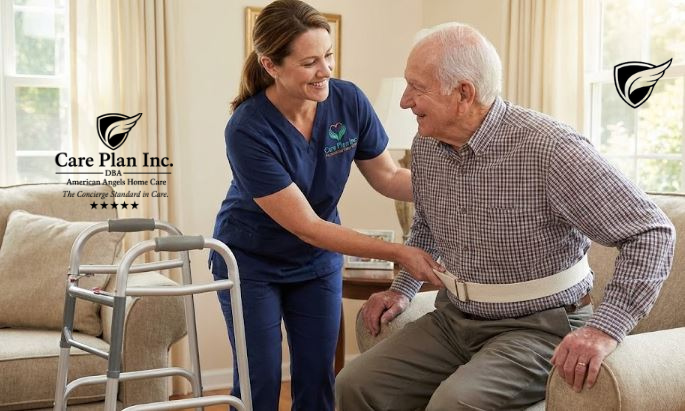
In contrast, home care allows the senior to remain the master of their own environment. When led by a Registered Nurse, this model provides a “hospital at home” level of clinical precision. The caregiver assists with Activities of Daily Living (ADLs) such as bathing, dressing, and mobility, but they do so under a plan of care signed and monitored by an RN. This ensures that the clinical safety net is robust without the traumatic displacement of moving to a facility.
The Nurse-Led Advantage: Clinical Peace of Mind
A primary concern for families choosing home care is the perceived lack of medical oversight. Care Plan Inc. addresses this by implementing a nurse-led framework where every caregiver acts as a clinical extension of the Registered Nurse. This is vital for families in Southeast Michigan who are navigating complex conditions like Parkinson’s, Alzheimer’s, or heart failure.
Proactive Triage and Condition Monitoring
When care is provided in a nursing home, subtle shifts in health can be missed due to high resident-to-staff ratios. In a nurse-led home care model, the caregiver is trained to spot “micro-changes”—a minor change in skin color, a slight decrease in appetite, or a subtle shift in verbal clarity. These markers are reported immediately to the supervising RN, who can triage the situation and communicate with physicians at Henry Ford Health or Corewell Health. This proactive clinical bridge is what prevents the emergency room visits that often lead to permanent institutionalization.
Comparing the Return on Investment (ROI)
Cost is a significant factor for any family, but it must be weighed against the level of individual attention and the risk of health complications. In high-value Michigan markets, the financial structure of care differs greatly between the two models.
The Value of Scalability in Home Care
Nursing homes charge a high, fixed monthly rate for room, board, and care, regardless of the senior’s daily status. Private duty home care is highly scalable. Families can implement a “maintenance” level of care (perhaps 12 to 20 hours a week) to establish safety and monitor health. This allows you to pay only for the professional time required, preserving family assets while providing a much higher standard of 1:1 attention. If you are ready to evaluate a clinical, concierge approach, the most effective next step is to start an intake to speak with a clinical coordinator.
| Planning Factor | Concierge Private Duty Care | Standard Nursing Home |
|---|---|---|
| Staffing Ratio | 1:1 Dedicated Focus | 1:12 to 1:15 (Distributed) |
| Environment | Private Residence; Familiarity | Institutional; Relocation Required |
| Personalization | Customized to Individual Routine | Standardized Facility Protocol |
| Clinical Oversight | Licensed RN Triage and Supervision | General Facility Management |
| Independence | High: Senior controls the rhythm | Low: Schedule set by facility |
Quality of Life: The “Environmental Anchor”
For a senior, familiarity is a cognitive and emotional stabilizer. The National Institute on Aging (NIA) notes that for those with cognitive changes, a familiar environment acts as an “Environmental Anchor.” The specific layout of a bedroom in Bloomfield Hills or the view of a garden in Birmingham provides a sense of security that reduces the agitation and anxiety often triggered by the unfamiliar sounds and sights of a nursing home.
Independence and Social Standing
Home care preserves the senior’s social standing within their community. They can continue to host visitors, participate in local clubs, and maintain their intellectual habits without the stigma of institutionalization. A professional caregiver facilitates these social engagements safely, acting as a concierge who handles the logistical burdens so the senior can focus on living. This preservation of autonomy is a clinical necessity for mental well-being.
Managing Safety and Liability for Michigan Families
Choosing a care provider is also a legal and financial decision. Many families in high-net-worth Michigan communities consider hiring independent caregivers to save on costs. However, this model carries enormous risks. According to the IRS Publication 926, most household workers are classified as employees, not independent contractors. This means the family is responsible for payroll taxes, FICA, and workers’ compensation.
The Agency Advantage: Asset Protection
Engagement with a professional agency like Care Plan Inc. transfers this liability to the provider. We directly employ our staff, manage all taxes, and provide comprehensive professional liability insurance. This protects the family estate from legal suits in the event of an on-the-job injury or a medical error. For families in Grosse Pointe or Bloomfield Hills, this protection of family wealth is as critical as the protection of the senior’s physical health. It provides a level of professional discretion and security that a nursing home or independent hiring cannot match.
Conclusion: Moving from Uncertainty to Authority
Choosing between home care and a nursing home is an act of respect for the senior’s history and a commitment to their future. While nursing homes provide a standardized safety net, the nurse-led private duty model offers a clinically superior, personalized environment that preserves the senior’s dignity and independence. By choosing a concierge approach, families in Southeast Michigan are investing in a wellness strategy that prioritizes longevity and quality of life. Do not wait for a medical emergency to define your parent’s future. Take the lead today by engaging with professionals who prioritize clinical precision and the individual’s autonomy. Proactive planning is the single most important factor in a successful senior care journey.
Frequently Asked Questions
Is home care safer than a nursing home?
For many seniors, home care is clinically safer because it provides a 1:1 ratio of attention. In a nursing home, the high resident-to-staff ratio increases the risk of unobserved falls and delayed responses to health changes. A nurse-led home care model ensures constant clinical monitoring.
Does Medicare cover long-term care in either setting?
Medicare is designed for short-term, acute medical recovery after a hospitalization. It does not cover long-term “custodial” care (help with daily activities) in a nursing home or at home. These services are typically funded privately or through long-term care insurance (LTCI).
How is a nurse-led agency different from a standard home care agency?
A standard agency is often managed by administrators with no clinical background. A nurse-led agency like Care Plan Inc. utilizes licensed Registered Nurses to perform assessments, develop care plans, and supervise caregivers, providing medical authority and triage.
Can home care manage a senior with advanced dementia?
Yes. Many families choose 24/7 “awake” supervision for seniors with advanced dementia. Being in a familiar environment reduces the agitation of the condition, and specialized caregivers use behavioral de-escalation techniques overseen by a nurse to manage symptoms safely.
What happens if a care emergency occurs at home?
Professional managed agencies have 24/7 on-call support. In a nurse-led model, the caregiver follows a clinical chain of command, triaging the situation and contacting the RN supervisor immediately, which often prevents unnecessary hospitalizations.
If you would like to learn whether nurse led private duty care is the right choice for your family, please request more information below.

